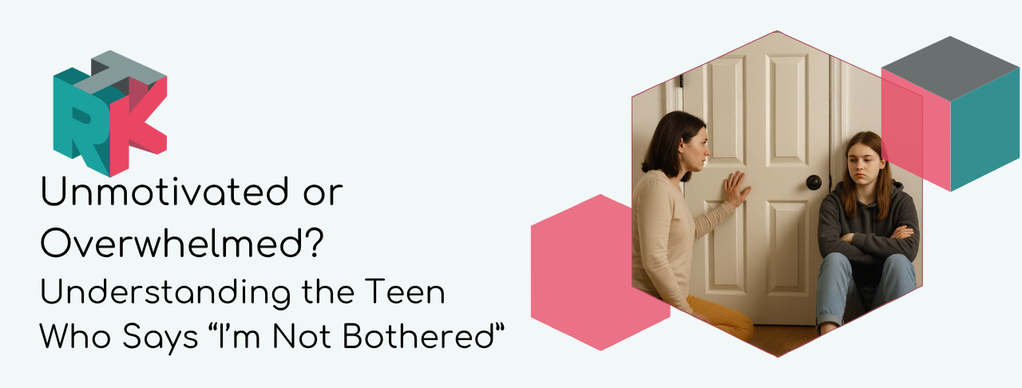
When a teenager says “I’m not bothered,” it can sound like laziness, defiance or a lack of motivation. But behind the shrug there may be overwhelm, fear of failure, perfectionism or low self-worth. Un
Understanding the Teen Who Says “I’m Not Bothered”
We all want our teens to care about their future, schoolwork, or even just their hygiene. But what do you do when you’re met with a shrug or silence? Before we assume they’re lazy or unmotivated, it’s worth looking a little deeper.
“I’m not bothered” is one of the most common phrases I hear from teens — and one of the most misunderstood. It often sounds like defiance or apathy, but in reality, it can be a quiet cry for help.
Let’s unpack what might really be going on behind the closed bedroom door.
When “I’m not bothered” means “I’m overwhelmed”
When teens appear shut down or indifferent, it’s easy to label them as lazy or unmotivated. But many are actually in survival mode, not by choice but by default.
What can look like resistance is often masking:
- Perfectionism – If they can’t do it perfectly, they don’t want to do it at all.
- Fear of failure – Trying and failing feels more painful than not trying at all.
- Emotional overload – School, friendships, identity, hormones — it’s a lot to juggle.
- Low self-worth – They may already feel like they’re not good enough, so protecting themselves with a “don’t care” attitude feels safer.
The procrastination and shut-down cycle
This often plays out like this:
- The task feels too big or too scary.
- The teen avoids it — by scrolling, sleeping, or zoning out.
- Deadlines loom, and anxiety spikes.
- Shame or panic creeps in.
- Parents intervene, often out of concern but with added pressure.
- The teen withdraws even more.
This creates a loop where avoiding the task feels safer than facing it. But that loop doesn’t build resilience — it builds fear.
How parents can help without adding pressure
You don’t have to fix everything. But your response can either build connection and capacity — or create more shutdown.
Here are five small shifts that make a big difference:
1. Ask what’s getting in the way, not why they’re not doing it
Instead of “Why haven’t you done your homework?” try “What’s getting in the way of starting it?”
This opens the door to a problem-solving conversation instead of a confrontation.
2. Help them chunk it down
What feels like “just do your coursework” to us may feel like 30 unknown steps to them. Help break the task into manageable parts.
Try: “Let’s look at the first step together and go from there.”
3. Validate first, solve second
Start with connection: “I get it — this feels like a lot right now.”
Then gently offer support: “What might make it feel more doable?”
4. Model what coping looks like
Let them see you starting tasks when you don’t feel like it, taking breaks, making mistakes, and trying again. That’s resilience in action — and it’s contagious.
5. Use metaphors they can relate to
Teens often respond better to metaphors than lectures.
You could say, “Your brain’s doing a software update — it’s not broken, just a bit glitchy.”
Or, “Let’s work on your ‘try again’ muscle instead of your ‘give up’ muscle.”
Final thoughts
When a teen says, “I’m not bothered,” they’re often anything but. They may be carrying the weight of not knowing where to start, how to cope, or what to do if they get it wrong.
Behind the shutdown is usually a sensitive, overloaded young person who doesn’t yet have the words — or the courage — to say, “I’m scared I can’t do this.”
And that’s where you come in.
Because when a trusted adult sees beyond the shrug, offers calm instead of criticism, and scaffolds instead of rescues, that’s when real resilience starts to grow.

Ashley Costello
Ashley is the founder of The Resilient Kid and The Resilient Academy, an experienced psychotherapist with over 30 years of experience supporting children, young people and families. As an author, TEDx speaker, podcaster and mum of two, Ashley is passionate about helping children understand their emotions, build confidence and develop lifelong resilience. Through her work with families, schools and Resilient Kid Coaches, she is on a mission to make emotional wellbeing support accessible to more children, empowering the adults around them to create environments where they feel safe, connected and able to thrive. Find out more about Ashley and her work: https://theresilienthub.co.uk/trh-coaches/ashley
No comments yet. Login to start a new discussion Start a new discussion