What can emperor penguins, sea turtles, chimpanzees and cheetahs teach us about raising children? Quite a lot, it turns out. To celebrate Sir David Attenborough’s 100th birthday, we look back at a lif
Celebrating 100 Years of the Man Who Showed Us the World
Today, Sir David Attenborough turns 100 years old. One hundred years of life. A lifetime of curiosity, wonder, and quiet devotion to this planet and every creature on it. And while he has never once claimed to be a parenting expert (who is?), over seven decades of filming the natural world he has — entirely by accident — created the most honest, moving, and instructive guide to raising children that has ever existed.
Not in a book. Not in a lecture theatre. But in the jungles, oceans, frozen tundras, and sun-baked plains he has brought into our living rooms.
So, in honour of his 100th birthday, here are the parenting lessons Sir David Attenborough never knew he was teaching us.
Patience Is Everything
Picture the male emperor penguin. Antarctica. Winter. The temperature drops to –60°C. There is no shelter, no food, no warmth. And yet he stands — perfectly still, perfectly devoted — balancing a single egg on his feet for two months while a blizzard rages around him. He loses a third of his body weight. He never complains. He never leaves.
Attenborough has narrated this scene in a voice so calm it almost makes you forget how extraordinary it is. And that's rather the point. In the natural world, patience isn't a virtue — it's a survival strategy. The parents who endure are the parents whose young survive.
We could learn something from the penguin. The next time a toddler insists on putting their own shoes on — wrong feet, painfully slowly, while you're already late — remember him standing in that blizzard. Your wait is considerably more comfortable.
Let Them Struggle
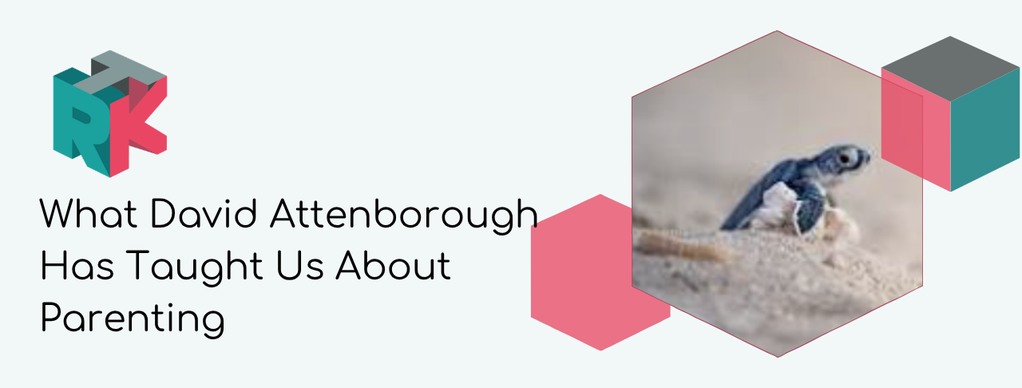
One of the most dramatic sequences in Attenborough's career involves newly hatched sea turtles. They dig themselves out of the sand, find the surface, and then — alone, tiny, with the whole ocean ahead of them and every predator in the sky above — they run.
The camera crew watches. Attenborough narrates. Nobody intervenes.
It's almost unbearable to watch. And yet this is precisely what the turtles need. The struggle is not a cruelty. It's a preparation. Every creature that makes it to the water is stronger for having fought its way there.
Modern parenting culture can be deeply uncomfortable with this idea. We smooth the path, anticipate the obstacle, and remove the discomfort before it lands. But children, like turtles, need to develop their own legs. They need to know what it feels like to try hard at something, to fail, and to try again. Our job isn't to ensure they never struggle. It's to be the safe shore they're scrambling toward.
Show, Don't Just Tell
Off the coast of New Zealand, an orca mother is teaching her calf to hunt. She doesn't explain it. She does it — over and over, slowly, alongside her young one — until eventually the calf begins to mirror her movements. It takes months. Sometimes years. She never loses patience with the repetition.
This is how the most sophisticated animal parents teach. Not through instruction, but through demonstration. Through presence. Through doing the thing, together, again and again, until it becomes second nature.
Children watch us with extraordinary attention. They notice how we speak to strangers, how we handle frustration, whether we say sorry when we're wrong, whether we keep our promises. They absorb all of it — long before they understand any of it. The lessons we teach by living are the ones that stick.
Play Is Serious Business
In the forests of West Africa, young chimpanzees spend hours every day in what looks, to the untrained eye, like chaos. They chase each other, wrestle, build rudimentary tools, act out social scenarios in elaborate mock dramas. It looks like fun — and it is. But Attenborough has always been careful to point out what it also is: essential.
Play is how young primates — including the human kind — learn the rules of society, develop empathy, test physical boundaries, and practise the art of negotiation. The child who spends an afternoon lost in imaginative play is not wasting time. They are doing some of the most complex cognitive and emotional work of their development.
We live in an age that is suspicious of unstructured time. Schedules are full, screens are everywhere, and "free play" can feel dangerously unproductive. But the chimps don't schedule their play. They just play. And they turn out remarkably well.
The World Is the Best Classroom
Attenborough has spent a century arguing — gently at first, with increasing urgency in his later years — that human beings need to reconnect with the natural world. Not merely for the planet's sake, but for our own.
An elephant calf learns to use its trunk, read water sources, navigate vast and complex landscapes, and understand the deep social structures of its herd simply by moving through the world alongside its family. There is no classroom. There is no curriculum. There is only experience, and the wisdom passed down by those walking beside you.
The research on children and nature is overwhelming and consistent: time outdoors reduces anxiety and improves attention. Contact with the natural world builds resilience, wonder, and a sense of connection to something larger than oneself. Children who grow up with access to green space are measurably happier.
Take them outside. Turn the screens off. Get mud on their knees. Let them be bored and watch what they discover. This is not a new idea — it's the oldest idea in the world. Attenborough has spent a lifetime showing us why it matters.
Know When to Let Go
Of all the scenes Attenborough has narrated, few are as quietly devastating as the moment a cheetah mother begins to withdraw from her nearly grown cubs. She stops sharing her kills. She distances herself. She watches them fail, and she does not come to their rescue.
It looks, on the surface, like abandonment. It isn't. It is the final and most essential act of her motherhood. She knows, in the wordless way that wild things know things, that her cubs' survival depends not on her continued presence but on her absence. That is the paradox at the heart of all good parenting: you raise them to leave you.
Every letting-go is a small rehearsal for the big one. The first morning at nursery. The first sleepover. The first time they walk to school alone. The gap year. The move across the country. Each one asks us to do what that cheetah does — to step back, to trust, to resist the urge to intervene — and to believe that what we gave them was enough.
A Final Thought
"No one will protect what they don't care about — and no one will care about what they have never experienced."
David Attenborough said that. He was talking about the natural world. But he might as well have been talking about childhood itself.
He has never written a parenting book. He has never sat on a panel and told us how to raise our children. He has simply — for one hundred extraordinary years — paid close and loving attention to the world, and shown us what he found there.
And what he found, again and again, in every corner of the planet, was this: that love, patience, sacrifice, play, and the gradual, courageous release of the next generation into the world are not uniquely human achievements. They are written into the fabric of life itself.
Which means, perhaps, we already know how to do this. We just need to remember that we are part of nature, too.
Happy 100th birthday, Sir David. The world is richer for every year you have spent showing it to us.

Ashley Costello
Ashley is the founder of The Resilient Kid and The Resilient Academy, an experienced psychotherapist with over 30 years of experience supporting children, young people and families. As an author, TEDx speaker, podcaster and mum of two, Ashley is passionate about helping children understand their emotions, build confidence and develop lifelong resilience. Through her work with families, schools and Resilient Kid Coaches, she is on a mission to make emotional wellbeing support accessible to more children, empowering the adults around them to create environments where they feel safe, connected and able to thrive. Find out more about Ashley and her work: https://theresilienthub.co.uk/trh-coaches/ashley
No comments yet. Login to start a new discussion Start a new discussion