
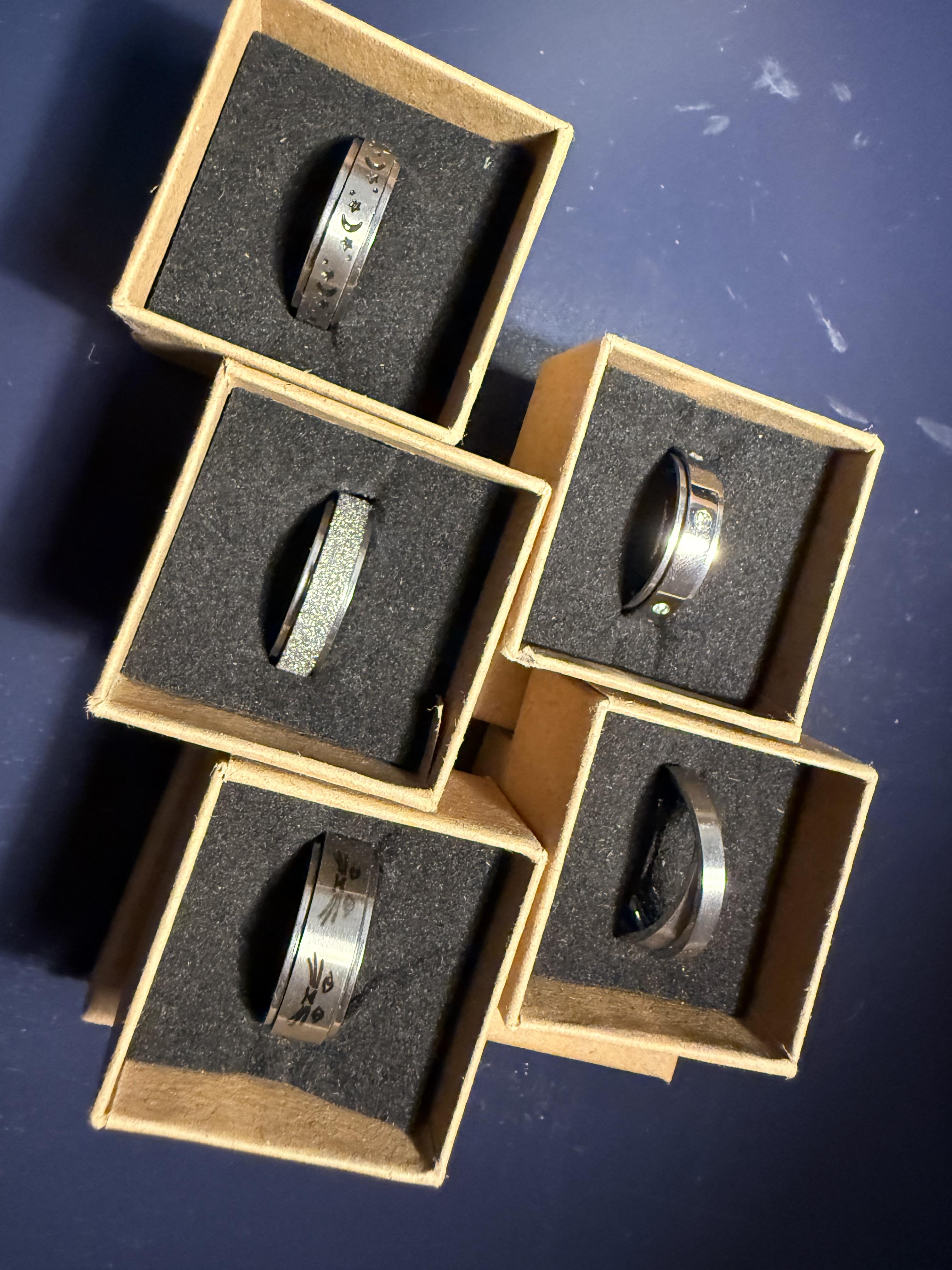
Something for busy fingers. A tool for calmer moments.
Sometimes concentrating, waiting, listening or managing big feelings is easier when our hands have something to do.
Our Fidget Rings are designed to provide a small, discreet way to fidget without needing to reach for a separate toy or tool. Depending on the style, children and teens can spin, twist, roll or move the ring, giving busy fingers repetitive movement while they get on with their day.
They can be particularly useful at school, while revising, travelling, waiting for appointments or during moments of worry or overwhelm. And because they look like ordinary jewellery, they can be a great option for older children and teens who want a fidget that doesn’t feel childish.
Fidgeting isn’t always a distraction. For some children and young people, small, repetitive movements can provide sensory input and give restless hands somewhere to go, which may help them feel more settled or make it easier to stay engaged with what they’re doing.
They’re not designed to make difficult feelings disappear. Instead, they’re another practical tool a child or teen can add to their Emotional Toolbox and discover whether it works for them.
We have a selection of designs, including sparkle, moon & stars, crystal detail, cat and twist styles. Each offers something slightly different to look at, touch or move, so children and teens can choose the one that feels most like them.
Our Fidget Rings are available in sizes 7, 8, 9 and 10.
For the best fit, we recommend measuring the finger before ordering and checking against our ring size guide.
Small enough to wear every day. Discreet enough to use anywhere. A little movement when you need it.
Choose your size
Our Fidget Rings are available in sizes 7, 8, 9 and 10.
Size 7 – 54 mm Size 8 – 57 mm Size 9 – 60 mm Size 10 – 62 mm
How to measure
Wrap a piece of string or a thin strip of paper around the finger where the ring will sit.
Make sure it feels comfortable — not too tight and not too loose.
Mark where the string or paper meets, then lay it flat against a ruler and measure the length in millimetres (mm).
Use the measurements above to find the closest size.
Between two sizes? Choose the larger size.